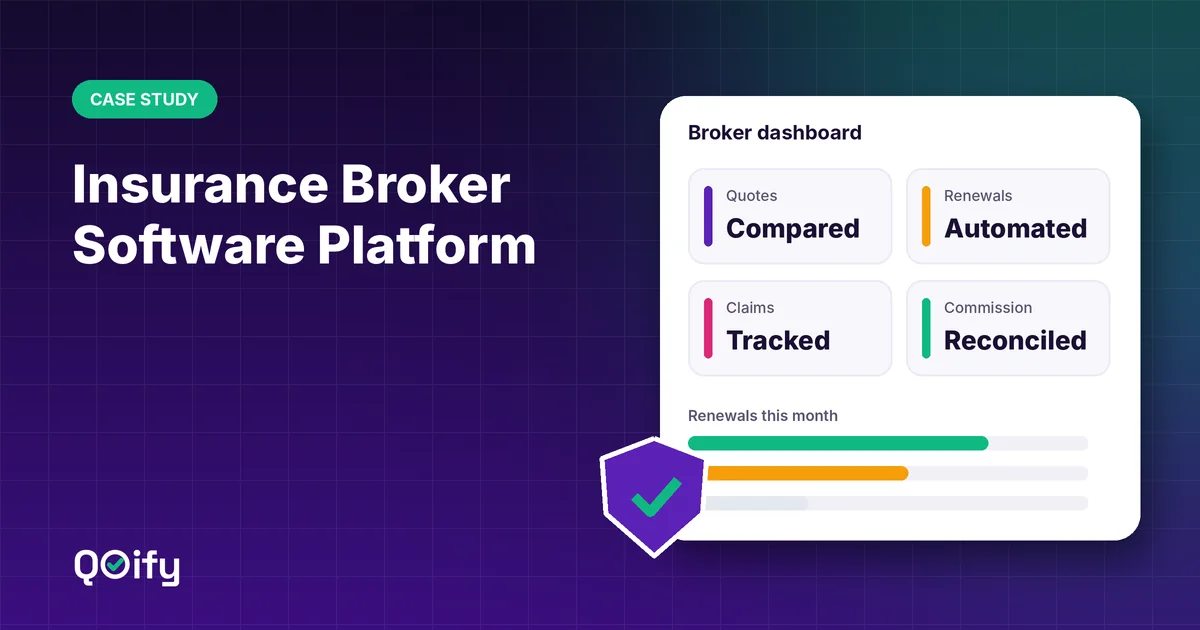
Template notice – replace every [bracketed] item with real project details before publishing. Real client names (with permission), real timelines and real, measured results are what make a case study trustworthy to readers, Google and AI search engines. Never publish invented numbers.
Project at a glance
| Detail | Value |
|---|---|
| Client | [Client name or "A mid-sized insurance broker in [city/country]" if the client prefers anonymity] |
| Industry | Insurance broking (general, health and life insurance) |
| Users | [Number] relationship managers, operations staff, POSPs/sub-agents and customers |
| Timeline | [X] months from discovery to launch |
| Team | [Roles and number of people from your side] |
| Services | Product discovery, UX/UI design, web & mobile development, cloud hosting, QA and support |
| Tech stack | [e.g. React, Node.js, MySQL, AWS – list what was actually used] |
The client
[Client name] is an insurance broker that helps individuals and businesses compare and buy policies from multiple insurers across motor, health, life and commercial lines. [Add one or two sentences about the client: years in business, number of customers or policies handled, regions served.]
The challenge
Like many growing brokers, the team was running the business on a mix of spreadsheets, email threads, WhatsApp messages and separate insurer portals. As the policy book grew, this created real problems:
- No single view of the customer. Policy details, documents and conversations were spread across inboxes and shared folders, so answering a simple customer question meant searching several places.
- Missed renewals. Renewal dates were tracked manually. When a reminder was missed, the customer often renewed directly with the insurer or moved to a competitor.
- Slow quote comparison. Staff logged in to each insurer's portal separately and copied premiums into a spreadsheet to compare options for the customer.
- Commission reconciliation was painful. Matching insurer commission statements against issued policies, and calculating payouts for sub-agents, took days of manual work every month and was prone to errors.
- Claims follow-up was hard to track. Customers called for updates, but there was no shared record of each claim's status.
- Compliance and audit pressure. Brokers must maintain proper records and follow the rules of their regulator (for example, IRDAI in India). Scattered data made audits stressful.
[Add the specific pain point the client emphasised most, ideally in their own words.]
Our approach
We started with a [X]-week discovery phase: interviewing relationship managers, operations staff and management, mapping the end-to-end policy lifecycle, and reviewing the insurer data formats the team worked with every day. From that, we prioritised features by business impact and built the platform in phases, releasing a working version to real users every [two] weeks so feedback shaped each step.
The solution: an all-in-one insurance broker platform
1. Customer & lead management (CRM)
A single profile for every customer with their policies, family members or business entities, documents, communication history and upcoming renewals. Leads from the website, referrals and campaigns flow into a pipeline that relationship managers work through.
2. Multi-insurer quote comparison
Staff enter the customer's requirements once and see quotes from multiple insurers side by side, with premiums, cover, add-ons and exclusions. [Describe whether quotes come via insurer APIs, rate tables or manual entry.] A clean comparison PDF can be shared with the customer in one click.
3. Policy management
Every issued policy is stored with its key data and documents: insurer, product, sum insured, premium, start and end dates, endorsements and nominees. Policies can be searched and filtered instantly.
4. Automated renewal engine
The system tracks expiry dates and automatically sends reminders to customers and assigned staff by email, SMS and WhatsApp at configurable intervals (for example 45, 30, 15 and 7 days before expiry). A renewal dashboard shows what is due, contacted, quoted, renewed or lost.
5. Claims tracking
Each claim is logged with its documents, insurer reference and status history. Customers receive status updates automatically, and managers can see pending claims and how long each has been open.
6. Commission & payout reconciliation
Insurer commission statements are imported and automatically matched against issued policies. Mismatches are flagged for review, and payouts to sub-agents or POSPs are calculated from configurable rules, with statements generated automatically.
7. Document vault
Proposal forms, KYC documents, policy schedules and claim papers are stored securely against the right customer and policy, with role-based access and an audit trail of who viewed or changed what.
8. Customer and partner portals
Customers can log in to view their policies, download documents, request renewals and track claims. POSPs and sub-agents get their own portal to submit leads and view their business and commissions.
9. Reports and MIS
Real-time dashboards for management: new business, renewals, retention, premium and commission by insurer, product, branch and team member, exportable to Excel.
10. Security and compliance
Role-based permissions, encrypted data storage and transfer, complete audit logs, regular backups and data-retention settings designed around the client's regulatory obligations.
Results
[Replace this section with measured results. Only include numbers you can verify from the client's data, and get the client's approval to publish them. Examples of what to measure:]
- Renewal retention: from [X]% to [Y]% within [timeframe]
- Time to prepare a quote comparison: from [X minutes] to [Y minutes]
- Monthly commission reconciliation: from [X days] to [Y hours]
- Customer queries about policy or claim status: reduced by [X]%
- Policies managed on the platform: [number]
Client feedback
"[Add a real quote from the client, with their name and role, only with their permission.]"
— [Name], [Role], [Company]
Key lessons for insurance brokers going digital
- Start with renewals. Automated renewal tracking usually delivers the fastest, most visible return, because it protects revenue the broker has already earned.
- Get the data model right first. Customers, policies, endorsements, claims and commissions are tightly connected. A clean structure makes every later feature easier.
- Design for the people doing the work. Relationship managers and operations staff adopt a system that saves them clicks every day.
- Plan integrations early. Insurer APIs, payment gateways and messaging providers each have their own formats and approval processes.
- Build compliance in from day one. Audit trails, access control and data retention are far harder to add later.
Planning software for your insurance broking business?
Whether you need a complete broker platform or want to automate one part of your workflow, such as renewals or commission reconciliation, contact our team to discuss your requirements.